

Speeding is one of the biggest causes of deaths and serious injuries on ACT roads. Speed was identified as a factor in 13 fatal crashes (43% of all fatal crashes) in the ACT over the years 2021-23.
Casual speeding? Every K counts
Our latest speeding campaign ‘Casual speeding. Every K counts’ focuses on low range speeding. This is the kind of speeding you might think won’t make a difference. But just 5 or 10 kilometres over the speed limit really can make all the difference. The campaign demonstrates the real risks and consequences of going ‘just a bit’ over the speed limit or driving too fast for the conditions.
Let’s stop being so casual about speeding.
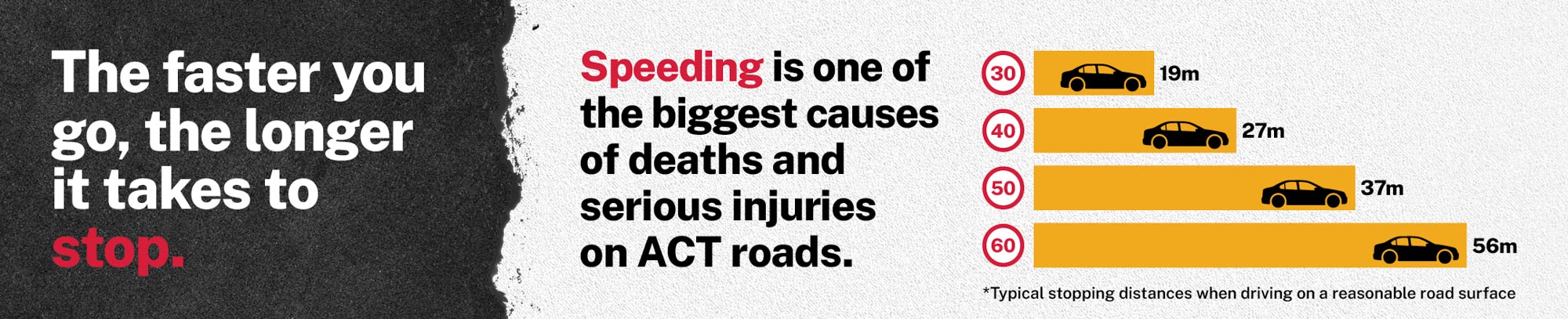
Impacts of speeding
Speeding at 5 km/h above the speed limit increases both the likelihood of a crash, and the severity of driver and pedestrian injuries in a crash.
The relationship between speed and injury severity is particularly critical for vulnerable road users such as pedestrians and cyclists.
When a car travels at 30 km/h, pedestrians have a 90% chance of survival when struck.
When a car travels at 45 km/h, pedestrians have a less than 50% chance of survival when struck.
When a car travels at 80 km/h, pedestrians have almost no chance of surviving an impact. For car occupants, the likelihood of death is 20 times what it would have been at 30 km/h.
Every driver can make a real difference by making the safe choice to never exceed the limit – not even by a few extra kilometres per hour – and driving to the road conditions every time they get behind the wheel.
Speed limits
Speed limits are used to regulate traffic flow and promote safety for all road users. The ACT Government has a systematic approach for determining and reviewing speed limits.
50 km/h default speed limit
The default speed limit in the ACT is 50 km/h.
The exceptions to the 50 km/h limit are:
- major roads, which are signposted at 60 km/h
- school zones and town centres, which are signposted at 40 km/h.
If you are travelling on a 60 km/h road within the ACT, the lower limit will apply as soon as you turn off that road onto a road without a speed sign.
Signs advising of the 50 km/h speed limit are installed at all entry roads to the ACT to inform interstate motorists.
The 50 km/h speed limit is enforced by the police in the same way as all other speed limits in the ACT.
40 km/h school speed limits
In the ACT, most schools are not located on or near major arterial roads. The ACT has a 40 km/h speed limit on certain streets in school zones. This reduced limit applies for the times and days marked on the school zone signs, typically from 8 am until 4 pm Monday to Friday. The limit helps to ensure a low-speed environment near schools and school crossings.
The school zone signs are erected at the entrance to these zones and are designed to be “closed” or “open”. When “open” the zone is 40 km/h, and when “closed” the default 50 km/h speed limit applies unless otherwise signposted.
40 km/h in town centres
There are 18 town centres in the ACT with 40 km/h speed limits: Amaroo, Calwell, Charnwood, Chisholm, Conder, Curtin, Dickson, Erindale, Hawker, Jamison, Kaleen, Kambah, Kingston, Kippax, Manuka, Mawson, Wanniassa and Weston.
The 40 km/h speed limits are in place 24 hours a day, seven days a week. A 40 km/h speed area can significantly reduce the risk of death for vulnerable road users.
