
Find out how to report a concern, how City Services arborists assess public trees, and how inspection and maintenance work is prioritised.
Reporting a public tree concern
Report a public tree on Fix My Street if it appears unstable or damaged, obstructs a road, path or cycleway, affects sightlines, has fallen, or may present another immediate hazard.
If a tree is touching power lines or has fallen and brought down power lines, please contact Evoenergy on 13 10 93.
For emergencies involving an immediate threat to life, call 000. For other urgent public tree concerns, contact Access Canberra on 13 22 81.
What happens after you report a concern
When you report a concern, a City Services officer will review the information provided and determine the appropriate assessment priority. Reports of hazards that are considered to pose an immediate concern (received through Fix My Street or via Access Canberra) are assigned the highest priority level for assessment.
On-call officers monitor Fix My Street requests and Access Canberra phone lines after hours to ensure urgent matters can be promptly addressed.
We aim to acknowledge or respond to all requests, regardless of priority level, within 10 business days. This does not mean works will be completed within 10 days. Work timing depends on priority level, risk, complexity, access, approvals, weather and available resources.
Guidance for cyclists and path users
Tree-related hazards on or beside a path may include fallen trees or branches, hanging or broken branches, reduced sightlines, roots obstructing a path and branches extending into the travel path.
Look up! Potential obstacles can be obscured, particularly if path users are wearing a hat or helmet.
If you see a potential hazard, slow down and keep a safe distance. Do not pass beneath loose hanging branches, or branches that appear too low to pass under safely. Do not approach a tree if it appears unstable, or where there is evidence of soil movement around the base of the tree. Use an alternative route where possible and warn other path users, if safe to do so. Report the hazard as soon as possible and provide a clear location, description and/or photo through Fix My Street or by calling 13 22 81.
When reporting urgent safety risks, it is important to indicate that the obstacle may cause a slip, fall or injury if you believe this to be the case. Providing details and photographs can assist further to promptly identify hazards.
Inspection process
Our qualified City Services arborists use the standardised VALID risk-benefit assessment method when inspecting reported tree issues. Each inspection involves a visual tree assessment, site observations and an assessment of the potential risk to community. The aim is to ensure tree health, benefits, safety and co-existence with existing infrastructure are appropriately considered and weighted.
VALID is a tree risk-benefit system that operates in line with ISO31000 guidelines. It is the current risk assessment methodology adopted by ACT Government to support consistent and transparent tree assessments. It does not replace professional judgement. Inspecting arborists are qualified professionals and trained (VALID) Validators who use the methodology alongside their expertise, experience and site-specific observations.
Many trees are routinely observed by staff, contractors and members of the community during day-to-day activities, helping identify issues that may require further assessment.
Inspection priorities
City Services uses a risk-based approach that considers both the condition of the tree and how people use the space around it. A tree is more likely to require urgent attention when there is a high likelihood of failure and when people, vehicles or cyclists are likely to be present in the area that could be affected. Busy roads, shopping areas, schools, high-use parks, transport routes and other high-occupancy locations may, therefore, receive priority for inspections and associated works. At lower-use sites, the same type of tree defect may present less immediate exposure risk because people are present less often, allowing the risk to be managed within a planned timeframe. Lower-use sites are generally inspected in response to reports from the community (via Fix My Street), or when identified by crews undertaking a program of work in the area.
Priority levels
Priority levels are assigned after the tree assessment by applying the VALID risk rating to work categories. Emergency risk-reduction work receives the highest priority. Outside emergencies, the highest risks are addressed first.
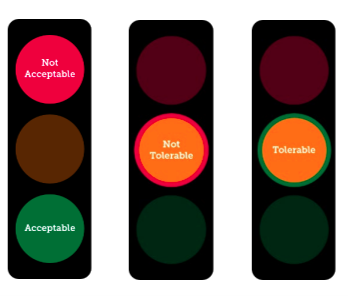
Red means not acceptable: Risks are prioritised for reduction to an acceptable level as soon as reasonably practicable.
Amber means not tolerable: Risks will be reduced to an acceptable level, with a lower priority than red not acceptable risks.
Amber means tolerable: Risks will not be reduced but may require more frequent assessment than green acceptable risks.
Green means acceptable: Risks will not be reduced.
Priority | VALID rating | Target response time* | Details |
|---|---|---|---|
Urgent | Red: Not acceptable | Less than 48 hours | A not acceptable risk is urgent when the inspecting arborist determines that failure or injury may be imminent or highly likely and people, vehicles or cyclists are likely to be present in the area that could be affected. Interim controls (e.g. signage, diversions) and/or urgent tree work are arranged as soon as practicable. |
High | Red: Not acceptable | 3 months | Risks assessed as not acceptable must be reduced but have not been assessed as requiring immediate or urgent response. This may be because failure is less likely in the immediate future, the affected area is used less frequently and/or temporary controls can reduce exposure. Risk-reduction work is scheduled as soon as practicable within the target response time. |
Medium | Amber: Not tolerable | Program of work | Risks assessed as not tolerable. |
Low | Amber: Tolerable and Green: Acceptable | No works required | Risks assessed as acceptable and tolerable, noting some tolerable risks may require monitoring. |
*Typical target response times are subject to operational priorities, weather, access, emergency events and resource availability.
^ A red not acceptable rating means action is required to reduce the risk, but it does not automatically mean the risk is urgent. An urgent not acceptable risk requires a rapid response because failure may be imminent or highly likely and people, traffic or other targets are likely to be exposed. A non-urgent not acceptable risk still requires risk-reduction work, but the likelihood of harm or the level and frequency of exposure is lower, so the work can be safely scheduled within the high-priority timeframe.
Maintenance approach
Maintenance may be proactive, cyclical or reactive. Works will seek to maintain tree health and natural form, provide necessary clearances, manage risk and protect people, animals and infrastructure.
The ACT Government has a duty of care to manage the risk from urban trees as government assets. When managing risk, ACT Government employees must act reasonably, proportionately, and where action is reasonably practicable. There is a balance between the many benefits trees provide, the level of risk, and the costs of managing that risk.
This balanced approach helps ensure resources are not used for unnecessary risk-reduction work that would also reduce the benefits of trees assessed as having acceptable or tolerable risk levels.