
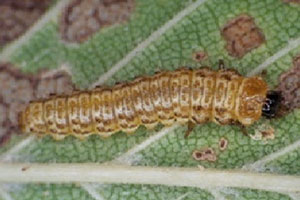
The elm leaf beetle (Pyrrhalta luteola) is native to Europe, north Africa and Eurasia. The larvae skeletonise leaves by eating around the outer edge and veins. Although this causes damage to elm trees, and can reduce their health and strength, there is little risk of affected trees dying.
The beetle hibernates from April to September, lays eggs in November and new beetles emerge over summer.
Treating elm leaf beetle
Elm leaf beetles are established in Canberra but they can be managed.
The ACT Government has trialled several elm leaf beetle treatments. Unfortunately, they are expensive and must be repeated every 2 to 3 years at least to be effective. With around 10,000 elm trees growing in Canberra’s urban areas, these ongoing treatments are not viable.
Tree care
The best way to combat elm leaf beetle damage is to improve tree health. Healthy trees are less likely to be heavily infested with elm leaf beetles. They are also more tolerant to foliage damage.
Remember to:
- keep the tree watered in dry periods
- fertilise in late winter with slow-release fertiliser
- avoid compaction of soil over the root zone
- encourage good soil conditions by covering root zone with mulch rather than lawn.
It’s also recommended that mulch and woody debris beneath the tree are removed in late autumn and winter. This reduces nooks and crannies in which elm leaf beetles can hibernate over winter.
Trunk banding
Trunk banding is the simplest way to break the life cycle of the elm leaf beetle. Experiments at the Keith Turnbull Research Institute showed that insecticidal banding can be effective in reducing the damage to leaves by more than 50% in English elms, over a three-year banding program.
The banding must be applied at the right time in the life cycle. To band a tree, observe the growth of the larvae and place a sticky band around the elm tree trunk in early December. The larvae will move down the trunk, usually around Christmas. Many larvae will be trapped on the band as they descend the tree. However, some larvae will drop directly from the leaves onto the ground. Banding will also not catch adult beetles, which can fly back into the tree.
Commercial bands can be bought from horticultural suppliers.
Chemical control
There are many chemicals registered for the control of elm leaf beetle. They can be applied either as a foliar spray, soil drench or soil injection. When using chemicals, always read the label first and follow the guidelines. Talk to staff at your local garden centre if you have questions.
Contact us
If you’re concerned about the health of a tree on ACT Government land, contact Access Canberra on 13 22 81.