
On this page:
Standard terms and conditions
Permit holder responsibilities
This permit authorises the permit holder for the use of unleased territory land only. It is the responsibility of the permit holder to seek all necessary advice on further licensing requirements by other agencies (e.g. Access Canberra for liquor licences, Roads ACT for road opening and closing, Environment Protection Authority for noise related permits and the National Capital Authority for the use of national land) in relation to the activity. In addition, it is the permit holder’s responsibility to understand and abide by all WorkSafe ACT obligations associated with your activity. Further information is available on the WorkSafe ACT website.
- Public Unleased Land Act 2013, section 44, states it is an offence when a person fails to comply with the conditions of a permit. This may deem the person unsuitable (under sections 46 & 47) to hold a permit in the future.
- Consideration is to be given to other bookings within the area. Approval does not guarantee exclusive use of the area, unless prior approval is granted by the land manager, the land always remains a public place.
- The permit holder is to notify all adjacent businesses or residents, where an activity may temporarily impact public amenity, such as physical access, noise or visual impact. A minimum of 3 days prior to the event commencement date.
Additional conditions
Approval for an activity on public unleased land may include site or activity-specific conditions as determined by the Directorate.
BBQs
A drip tin of at least 5 litre capacity must be used to collect fat dripping from the cooking surface. All fat, food and rubbish must be removed from the site. This will include washing the surrounding pavement with hot soapy water, if the BBQ is conducted on hard stand. A First Aid kit must be carried and be equipped for major and minor burns and must include a Fire Blanket.
A fully charged Fire extinguisher (as suggested by the ACT Fire Service) must be available in case of emergency. In the event of a Total fire ban you may not use your own BBQ but can still use the existing park barbeque facilities.
- In the case of a public BBQ fault, applicant should provide a backup cooking source. Please report all faulty BBQs to Access Canberra on 132281.
- Public BBQs cannot be privately booked and must remain accessible to the general public.
Cancellation or modification of approval
The City and Environment Directorate may include additional conditions or cancel a permit at any time if required for public safety or other reasons. This includes the likelihood of damage to Territory property as a result of rainfall, total fire ban or other natural events or conditions. In such cases, the Territory will not be liable for any losses incurred by the permit holder but may consider refunding any fees paid. Should the need arise for the area to be vacated as advised by the Territory. The permit holder should, as a matter of courtesy, inform the public land use team if an approved activity is to be cancelled or modified for any reason.
If the permit holder breaches any term or condition of this permit agreement, the Territory may immediately terminate this permit without prejudice to any claim which the Territory may have against the permit holder under this agreement.
Damage to territory property
The permit holder will be responsible for any damage to Territory property caused by the activity. This includes damage to roads, footpaths, kerbs and gutters, fences, gates, furniture, signs, BBQs, trees, verge vegetation (including turf), irrigation systems or any other property. The permit holder agrees to report any such damage to the public land use team on 13 22 81 or emailing the public land use team as soon as practicable, and to repair the damage or reimburse the Territory for costs incurred in repairing the damage to the Territory's satisfaction.
The permit holder shall immediately on receiving a direction by the Territory, at the cost of the permit holder, remove any temporary installations placed or erected in contravention of this permit agreement. All repairs to, or the replacement of any street, road, footpath, drain, tree or any other property of the Territory damaged as a direct or indirect result of any act or omission of the permit holder, its servants, agents or subcontractors shall be done by the permit holder at the cost of the permit holder, to the satisfaction of the Territory.
The permit holder shall be liable for any costs incurred by the Territory in removing any obstruction to any storm water channel, footpath or roadway caused by the permit holder, its servants, agents or subcontractors and any rubbish, debris or building materials left in any street, road or public place in the vicinity of the land by the permit holder, its servants, agents or subcontractors.
- Area to be restored as per the ACT Government’s Municipal infrastructure technical specifications (MITS), at the completion of the works to the satisfaction of City and Environment Directorate, or in compliance with any development approvals or works approvals issued.
Damage to public artworks
The permit holder is responsible to check if public artworks are located within their permitted area. If so, the artwork must be protected from damage. All damage to ACT artworks must be repaired to the satisfaction of Arts ACT and at the expense of the permit holder. A list of Arts ACT public artworks and a map of their locations can be found on the Arts ACT website.
Dilapidation report
A dilapidation report is required to be supplied to the Development coordination team at CED.dcdevelopmentcoordination@act.gov.au and CED.Publiclanduse@act.gov.au. A dilapidation report is to show onsite conditions prior to site occupation and be approved by Design review and Asset acceptance within City and Environment Directorate prior to land use submission.
Drones
Drones are not considered as part of this application unless specifically requested, authorised and approved by all relevant agencies.
End of works and consolidation of the site (construction/major events)
- It is the applicant’s responsibility to email tccs.commlanduse@act.gov.au to arrange an onsite inspection with the area’s Technical Officer to confirm remediation works are to City and Environment Directorate (CED) standards.
- All damage to be repaired at the expense of the applicant to the satisfaction of CED.
- The area shall be restored to the ACT Government’s Municipal infrastructure technical specifications (MITS), at the completion of the works to the satisfaction of CED.
- All soft works are to be consolidated/ watered etc. for 26 weeks after final acceptance by CED to ensure that the site is adequately reinstated. Refer to the CED Standard specification for urban infrastructure works
- All hard works reinstated such as bollards and paved areas shall be reinstated to the satisfaction of CED or/and Roads ACT.
- Failure to rectify any damage to public land will result in further action taken including infringements and refusal for future permits.
- Any conditions set by the endorsed Landscape management and protection plans or Letter of design review that differ from the above, supersede conditions of consolidation set in this permit.
Exclusive use
It should be noted that although approval has been given to use unleased Territory land for your activity, it does not guarantee exclusive use of that land as it always remains a public place. Exclusive use may be considered only where the permit holder can adequately secure an area via an appropriate fence. The permit holder will be responsible for legally securing the fence and area within. The Territory will not request members of the public to vacate an area under permit. However, the Territory will seek to avoid any conflicts arising with other approved events or municipal activities.
Fees
Fees are charged for the use of public unleased land for commercial activities, events and gate/power access. Fees are determined under the Disallowable instrument under the Public unleased land Act 2013. Once determined the public land use team will provide an estimate of these fees to the permit holder for confirmation. Payment for events and activities with a per-person charge must be made within 7 days of the end of the event after final numbers are known, unless otherwise arranged. Invoices will be generated for applied fees and failure to pay associated fees may result in the cancellation of the permit and/or compliance action being undertaken. All invoices generally carry a 30-day payment period, however the public land use team may adjust this requirement.
Gate and vehicle access
It is the permit holder’s responsibility to leave the gate as found (open or closed, locked or unlocked), unless otherwise authorised by the City and Environment Directorate. A gate unlocked by the permit holder must be attended while open then locked after use. A fee may apply for gate access. If access to gates is required, a detailed map outlining the vehicle route will need to be supplied with the application. Vehicle access into irrigated parks will not be generally supported. If vehicle access is permitted, access must be kept to a minimum and must be for set-up and emergency purposes only. Vehicles over 4 tonnes are not permitted unless previously approved by the land manager. Permit holders are required to obtain the correct approvals from ACT Roads and comply with all conditions set out in the Traffic Management Authorisation.Care must be taken when moving though urban open spaces – The general public including pedestrians and cyclists have right of way and the activities must not obstruct the pedestrian footpath or thoroughfares. The applicant must assess the Weather condition, Ground Condition, safety, and clearances of the proposed access route prior to entering urban open space and Vehicle access will be cancelled/delayed if heavy rain has fallen before or forecast during the access period.
- If there is difficulty onsite with gate/power access please contact Access Canberra on 132281 and ask to speak with the place management on call supervisor.
- Pedestrian access and access to shopping centres to be maintained at all times
- At least 5 metres is to be kept clear from shop fronts and 10 metres to be kept clear from entrances to shopping centres.
- Safety barriers for pedestrian protection are required and are to comply with relevant guidelines and codes.
- It is the responsibility of the permit holder to ensure there is adequate authorised offsite parking for the contractors/workers/attendees/guests using this site. Failure to seek authorised offsite parking may result in termination of this permit.
- Penalties will apply if parking is set up on public land without approval.
- Where relevant, all efforts are to be made to ensure vehicle movements and associated activities are confined to existing formed trails and cleared areas.
Power access
If your activity is using power, any power leads crossing pedestrian areas must be suspended at least 2.4 metres above the pavement. Power cables must carry an inspection tag which is less than 3 months old. In case of a supply issue with the power source, applicant shall provide a backup power source. For further information please contact WorkSafe ACT on 13 22 81 or via email worksafe@worksafe.act.gov.au.
- If there is difficulty onsite with gate/power access please contact Access Canberra on 132281 and ask to speak with the place management on call supervisor.
Heritage
In the event that any unexpected Aboriginal places or objects are encountered during the event, all activities at those locations are to cease to allow for heritage assessment and management in accordance with Section 75 of the Heritage Act 2004. The discovery is to be reported to the Council at heritage@act.gov.au within 5 working days in accordance with Section 51 of the Heritage Act 2004.
Irrigation
Where there is an irrigation system in the park, it must be protected at all times. The control box must not be blocked and 24-hour access must be given to the park maintenance team. Where activities include erecting structures and/or driving pegs or stakes into grassed areas, pegs should not be driven more than 200 millimetres deep within irrigated areas. Where appropriate, you may be referred to the park maintenance team to arrange for the marking of the irrigation system. The permit holder shall ensure that every stormwater channel adjacent to the land is kept clear of obstruction at all times and pedestrians/vehicles have access to all footpaths and roadways not limited by the approved permit. Vehicles must not drive over irrigation spray heads.
Legal compliance
The permit holder must ensure that all persons involved in the activity are aware of and abide by laws and regulations governing the area, as shown by local regulatory signage and any additional conditions that may be attached to the approved application.
Privacy statement
The City and Environment Directorate adheres to the ACT Information Privacy Act 2014. As a rule, the personal information that is provided to us is not passed on to private organisations or third parties without your written consent. However, your information may be provided to internal government agencies, to allow appropriate permit assessment or compliance requirements, and to the ACT Civil and Administrative Tribunal (ACAT) or another court or tribunal if required by law. Please see the information privacy policy for more details.
Public safety and insurance
The permit holder will take all reasonable steps to ensure the safety of the general public in the activity. In particular, the permit holder will inspect the area immediately prior to use to ensure that it is safe for that use and report to the Territory as soon as possible any hazard detected on that inspection. Permit holders must provide evidence of a current public liability insurance policy to a value of at least $20 million, or as determined by the ACT Insurance Authority in conjunction with City and Environment. Dependant on your activity you may be covered under the ACT Government public liability insurance scheme.
Public liability insurance for small community activities
Previously, all activities requiring a land use permit required the applicant to have public liability insurance to the value of $20,000,000 (minimum). This requirement was prohibitive for some community groups and individuals.
In response to the above reform, the ACT Government reviewed the requirement for permit holders to have public liability insurance. Where a business, commercial entity or incorporated group is involved, those organisations will still require their own appropriate public liability insurance. However, the ACT Government will extend its public liability insurance to cover some low risk non-commercial or not-for-profit activities for groups that do not have their own standing public liability insurance as listed in the table below, subject to the information provided, a permit being granted, and conditions being met.
For all other activities or requirements not listed in the table, applicants are required to have public liability insurance.
Low risk non-commercial or not-for-profit activities for which the ACT Government may extend its public liability insurance cover. The event must have no more than 75 people attending at any given time, and meet all of the following conditions:
Additional services/infrastructure associated with proposed activity | Conditions |
|---|---|
Gate access - vehicle |
|
Gate access - pedestrian |
|
Access to power |
|
Structures For example:
|
|
Serving food |
|
Serving alcohol |
|
Removal of litter and waste
The permit holder will ensure that all litter and rubbish resulting from the activity is removed from the site regularly, and immediately after the end of the activity and that no building rubbish, debris or building materials are left in any street, road or public place, this includes temporary signage.
Applicant is responsible for the cleaning of paved areas with a high-pressure steam cleaner if required.
Compliance action may be taken if the removal of litter and waste from public land is not undertaken as a result of the activity.
- Applicant should consider toilet facilities for participants/spectators when organising their event/activity. Information on facility requirements can be found below and information about on site facilities can be found on the ACT Government public toilet map.
The tables below provide guidance on the provision of toilet facilities at events.
Toilet facilities for events where alcohol is not available
Patrons | Males WC | Males urinals | Males hand basins | Females WC | Females hand basins |
|---|---|---|---|---|---|
<500 | 1 | 2 | 2 | 6 | 2 |
<1000 | 2 | 4 | 4 | 9 | 4 |
<2000 | 4 | 8 | 6 | 12 | 6 |
<3000 | 6 | 15 | 10 | 18 | 10 |
<5000 | 8 | 25 | 17 | 30 | 17 |
Toilet facilities for events where alcohol is available
Patrons | Males WC | Males urinals | Males hand basins | Females WC | Females hand basins |
|---|---|---|---|---|---|
<500 | 3 | 8 | 2 | 13 | 2 |
<1000 | 5 | 10 | 4 | 16 | 4 |
<2000 | 9 | 15 | 7 | 18 | 7 |
<3000 | 10 | 20 | 14 | 22 | 14 |
<5000 | 12 | 30 | 20 | 40 | 20 |
Risk management plan
It is the responsibility of the permit holder to ensure the Risk management plan conforms with current best practice and must include all appropriate risk management strategies to adequately manage risk associated with the permit activity. City and Environment Directorate does not review or approve the strategies within the Risk management plan. The permit holder, who is in control of the site is responsible for the development and maintenance of all management measures to control potential hazards associated with an activity.
Road and lane pathway closures
Any closure of a road-related area (including a lane or shared path) requires a valid permit, an approved Temporary Traffic Management Plan (TTMP), and Public Liability insurance with a minimum cover of $20 million. In some cases, fees apply to the closure of public roads and pathway systems; where fees are applicable, your application must include an approved fee calculator issued by Roads ACT. Supporting documentation is mandatory. This permit is conditional upon the submission and approval of authorised Traffic Management Plans (TTM Plans) and is valid only where an approved TTMP and current Public Liability insurance are in place. You must upload approved Traffic Management Plans only; submission of unapproved documents, including draft, incomplete, or temporary TTMPs, is strictly prohibited and constitutes a breach of permit conditions and may result in compliance action, including suspension or cancellation of the permit. This permit remains valid only for the duration covered by the approved supporting documentation. If the supporting approvals expire, are withdrawn, or are found to be invalid at any time, the permit may be suspended or cancelled.
Site compounds
Construction compound must not interfere with members of the public or thoroughfares. Weighted support footings must not be in pedestrian walkways.Construction compound or scaffolding shall not interfere with existing trees or structures. Permit holder to maintain a 1m strip of public land around the perimeter of the site to the satisfaction of the Land custodian, grass not to exceed 200mm in height. Location of the construction compound must not interfere with line-of-sight requirements for vehicles and pedestrians. Permit holder is responsible for any items left in the site compound and it is an offence to store materials outside of the designated construction compound.
Skip bins
Where your application includes the placement of a skip bin on public unleased land, please refer to the conditions below.
General conditions
A skip bin cannot be placed on a neighbouring nature strip without written agreement from the owner of the adjacent property. Non-adherence to the conditions within the permit are considered a breach under the Act. Warnings and infringements may apply. Approval will be considered void if all conditions are not adhered to during the use of the land.
As onsite conditions may vary, authorised officers may inspect the area and request additional conditions or relocation of the skip bin if there are concerns surrounding public safety or damage to territory assets.
Skip bins are permitted within the approved area for a maximum of 7 days from date of delivery. Additional approvals will be required for periods greater than 7 days. All approvals that are required from relevant authorities must be obtained and held for the duration of the permit. Area to be restored back to original condition at removal of skip bin, including reseeding of grass if necessary.
Line of sight
When placing the skip bin, the applicant must consider adequate sight distances for driveways and footpaths as the skip bin may impact drivers vision of pedestrians below the height of the skip. A minimum of 6 metres line of sight should be maintained around the skip when exiting or entering a driveway as to not interfere with line of sight requirement for vehicles and pedestrians.
Tree canopy
No activity associated with the skip bin (such as excavation, storage of materials and parking) is permitted under the drip line of a tree canopy.
Waste management
The skip bin must remain covered when not in use and overnight. At the end of each day all litter and waste associated with the works must be contained within the skip or removed from site. No materials should be stored around the skip.
The applicant will be responsible for any illegal dumping which occurs during the term of the public land use permit. The applicant is also responsible for the removal of all waste associated with the skip bin once it has been removed from public land.
Any waste not removed from the location will be collected by a CED contractor at the expense of the applicant /event organiser. An invoice will be issued to the event organiser if not rectified to satisfaction of CED.
Contaminated waste
The permit holder is responsible for investigating possible hazardous or contaminated waste within the permitted area. The permit holder must take all appropriate precautions and report to relevant authorities if any contamination is found.
Clearance zones
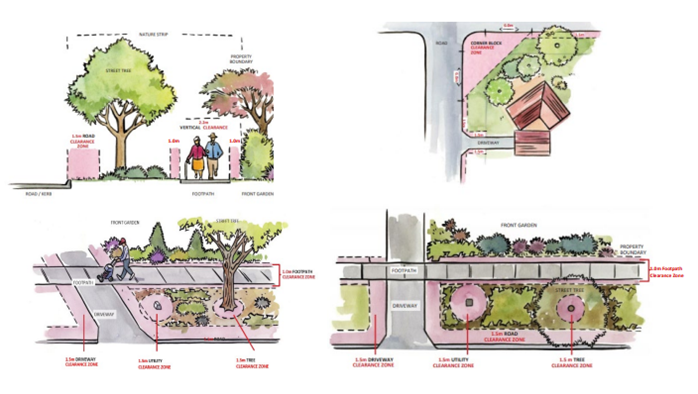
Location of skip bin must comply with clearance zones image and description below:
- Skip bin is not to be located within 1.5 m of the kerb. This allows for safe pedestrian and cyclist movements and the use of the area, such as opening car doors and placement of wheelie bins.
- Skip bin is not to be located within 1.5 m of a driveway.
- Skip bin is not to be located within 6 m of a corner block, as shown below.
- Skip bin is not to be located within 1 m on either side of the footpath.
- Skip bin is not to be located within 1.5 m of a utility e.g. meter pit, electrical box, fire hydrant, poles.
- Skip bin is not to be located within 1.5 m of an existing street tree (measured from the outside edge of the trunk).
Sound
Permit holders must ensure the sound generated does not impact adversely on nearby businesses or residents and must comply with the ACT noise standards. Further information on acceptable noise levels can be found by contacting the Environment Protection Authority on 13 22 81.
Standards, codes and guidelines
All works associated with the construction compound must meet the relevant Australian standards, codes and guidelines and other appropriate approvals such as but not limited to Development Approvals and NCA works approvals.
Structures - marquees (3x3) and private jumping castles
- No pegs or stakes are to be used to secure marquees, banners, animal enclosures or any other structures on public land. All structures are to be weighted down.
- Jumping castles are to be installed in accordance with manufacturer installation and fastening requirements.
- All food and cooking marquees are to have complete flooring. This is to prevent damage/stains to the hard-standing pavement and grass turf area.
- If any pegs or stakes are required in irrigated parks for safety reasons e.g. jumping castles or large marquees where the manufactures requirements state it to be pegged an additional bond and irrigation mark out may be required.
- Applicant may be required to arrange an irrigation infrastructure mark out with CED Irrigation Officer.
Structures on designated land
Several parks and locations within the ACT, such as Weston Park, Black Mountain Peninsula, Lennox Garden and Bowen Park, require works approval from the National Capital Authority for the erection of any structures on designated land. You will be advised if this requirement applies upon application.
Suitability information
In deciding whether a person is suitable to hold a permit, the director-general (or delegate of) must consider:
- any conviction or finding of guilt for an offence against the Public Unleased Land Act 2013 or a substantially corresponding law
- any non-compliance with a legal obligation in relation to carrying on an activity on public unleased land
- any previous refusal of a permit application
- any other matter relevant to the person’s ability to safely and responsibly carry on an activity on public unleased land.
Tree Protection
Public Trees (trees located in parks, nature strips, laneways, roadsides etc)
- No items are to be installed or fixed to a tree without prior approval from Urban Treescapes.
- Branch removal and pruning are strictly prohibited without prior approval from Urban Treescapes.
- No excavation is to occur within Tree Protection Zones*.
- All vehicles must stay outside of Tree Protection Zones* or follow existing hard surface paths and/or formal gravel paths when accessing the site. If the event site is only accessible through a Tree Protection Zone*, vehicle height must be taken note of to ensure no low hanging lateral limbs are damaged.
- There is to be no parking of vehicles or machinery within Tree Protection Zones*.
- Market Stall’s or Portable BBQ’s must not be set up within Tree Protection Zones* unless there is a minimum 4m vertical clearance above the BBQ to the nearest tree branch. There must be a minimum 1m clearance between the top of Market Stall’s and the nearest branch, and all structures within Tree Protection Zones are to be secured with sandbags or other weighted items rather than stakes.
- Portable toilets are not to be installed within Tree Protection Zones*.
- Waste and catering by-products must not be allowed to contaminate the ground within Tree Protection Zones*. For example, fats and oils, sugary syrups, cleaning products, or large volumes of ice must not be discarded or disposed of.
- If significant rain occurs and soils within the site are saturated, no activities/installations are permitted under the tree protection zone.
- Any tree damage must be reported to Urban Treescapes within 48 hours of completion of the event, please provide photos and include an explanation of how damage occurred (ced_cputddcoord@act.gov.au).
- If activities are proposed that are outside these tree protection conditions a tree management plan must be submitted to Urban Treescapes for approval. An approved tree management plan may override any of the above-mentioned tree protection conditions of use.
- If a tree management plan is approved by Urban Treescapes, all conditions set out in the tree management plan must met.
Registered Trees and Remnant Native Trees
- To identify if your event site has any registered trees or remnant native trees, please go to Home - ACTmapi: ‘Urban Trees Map’, using the ‘Registered Trees’ layer, and the ‘Environmental Map’ using the ‘Mature Trees’ Layer.
- There is to be no vehicle access, no parking and no event activities undertaken within the Tree Protection Zone* of a remnant native tree or registered tree.
- A Tree Management Plan specific to the activities of your event is required if operating within the Tree Protection Zone* of a registered tree or a remnant native tree is considered essential to the event.
- For further information on registered trees please email the Tree Protection team.
- For further information on all other public trees please email the Urban Treescapes Design and Development Coordination team or phone 02 6207 2805.
Tree Protection Zone definition
In the ACT, public trees have a Tree Protection Zone which is:
- Mature trees – Extent of the canopy spread plus 2 metres
- Juvenile trees – The 4 metre wide area surrounding the tree, or the extent of the canopy spread plus 2 metres, whichever is greater.
Utilities and services
It is the permit holder's responsibility to undertake all required dial before you dig and service checks and to ensure all due diligence checks are taken before operating under overhead powerlines. The utilities are privately owned and it is the responsibility of the permit holder to contact the provider/s for all required clearances. Any damage to utilities will be the responsibility of the permit holder to restore.
Works approval area
- Works Approvals are to be approved by Roads ACT and a copy of your Works Approval and plan is to be provided with your land use application.
- Works Approvals are granted for the following work activities only:
- Installation, modification, and removal of traffic control devices in accordance with the authorised temporary traffic management plan
- Excavation and construction of new services or assets on public unleased land
- Dates of physical works are to be clearly outlined with your public land use application.
- Commercial fees for use of public unleased land will not be implemented for the dates the works area is in use under a Works Approval. Commercial fees will be implemented for use of public land for commercial purposes outside of the Works Approval issued by Roads ACT.
Definitions
| Activity | The placement of an object or the holding of an event on public unleased land. |
| Applicant | The person who completes and signs the application to use a public place. Where the applicant represents an organisation or company, the applicant is assumed to have authority from the organisation or company to act on its behalf and enter into this agreement. |
| Guarantor | A guarantor is a person who guarantees to pay a borrower's debt in the event the borrower defaults on a loan obligation. A guarantor acts as co-signer because they pledge their own assets or services in case the original debtor cannot perform their obligations. |
| Guarantee/bond | A guarantee or bond may be required depending on the type of works/activity and possible potential damage to territory land. This determination will be made by the Assistant director, licensing. |
| Nature strip or verge | Nature strip or verge refers to the section of public unleased land directly adjacent to the front or side boundaries of the property. Additional approval will be required to access the rear of a property from public unleased land. |
| Permit holder | This is the person or entity named to whom a permit approval is granted, as named on the permit. |
| Rights – The parties agree that: |
The rights conferred by this permit agreement shall rest in contract only and shall not create in or confer upon the permit holder any tenancy or any estate or interest whatsoever in or over the land. The permit granted hereunder shall confer no right of exclusive occupation of the land to the permit holder, without express prior agreement in writing by the land custodian. The territory may at any time exercise all its rights as owner including its rights to use, possess and enjoy the whole or any |
| Territory | The territory refers to the ACT Government and its agencies. |
| City and Environment Directorate | City and Environment is a directorate within the ACT Government responsible for the management and use of unleased territory land. |