The ACT Government takes care of 129 sportsgrounds across Canberra. We undertake a range of activities including mowing, irrigation, line marking and soil testing. At different periods throughout the year maintenance can also include bulk fertiliser and decompaction of surfaces.
Twice a year, our sportsgrounds are closed for maintenance and to prepare for the winter sporting season.
We also use moisture content sensors to determine when sportsgrounds can be used after rain and to predict future conditions.
How we maintain our sportsgrounds
Maintenance closures
All ACT Government sportsgrounds are closed for the last 2 weeks of March and September. This is to make sure the grounds are ready for the following season's sports. This involves the installation/removal of goal posts and back nets where required.
Other activities during the shutdown include:
- aeration
- top dressing
- over sowing of bare or sparse areas to achieve an even turf cover
- day time irrigation of sportsgrounds to help establish new grass seeds.
During this time sportsgrounds cannot be used for organised or recreational purposes.
Grass types and mowing practices
There are 3 main types of grass species across our sportsgrounds.
- Cooch: used for sports requiring a shorter cut.
- Rye: used on high-profile fields like enclosed ovals.
- Tall Fescue: this is the thickest bladed grass and can withstand heavy traffic during peak periods.
Sportsgrounds are usually cut twice a week in the growing period and once a week in the winter where required.
For summer sports, grass is cut at 18 mm for sports such as turf cricket and 25 mm for general sports including touch football, soccer and Oz Tag.
During the winter sports season, grass is cut at 25 mm for the enclosed ovals and 35 mm for the unenclosed ovals.
Line marking
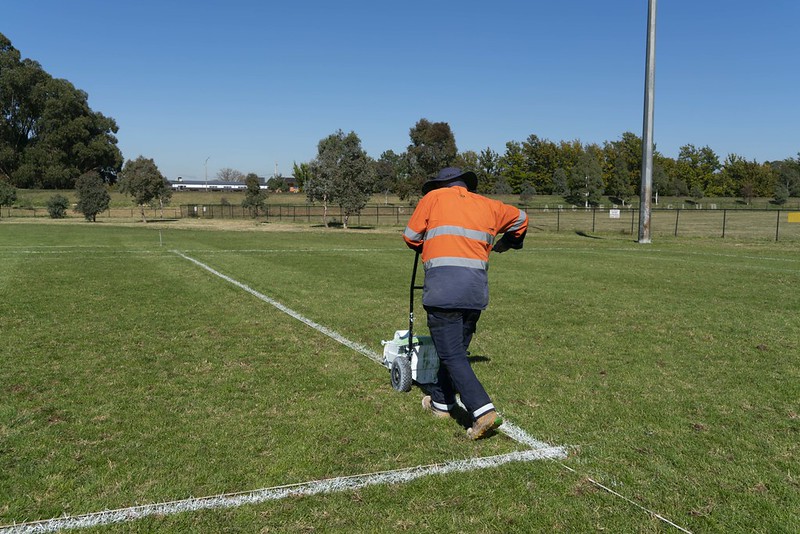
At the start of each season we line mark all required fields with white paint. Throughout the season this is the responsibility of sporting clubs.
The ACT Government manages 97 turf sports fields across Canberra, supporting both community and competition use. To improve efficiency, consistency and environmental outcomes, the City and Environment Directorate (CED) is increasing the use of robotic paint line marking. While this is the preferred approach, some sporting codes continue to use diesel line marking where required.
Robotic paint line marking uses lightweight, GPS-guided equipment to deliver accurate and consistent results. A standard athletics track can be completed in 4 to 4.5 hours, compared to around 5 hours using diesel, saving up to one hour per job. When two robots are used, marking time can be reduced to approximately 2.5 hours. Robots can also operate soon after rainfall and avoid access issues associated with heavy vehicles, improving overall scheduling reliability.
Paint marking is typically undertaken weekly during the playing season to maintain clear, competition-ready lines and support multi-sport use. In comparison, diesel markings can last longer but often fade unpredictably and are heavily influenced by weather conditions, resulting in inconsistent field quality and reactive maintenance.
Robotic marking also delivers significant cost and resource efficiencies. Paint marking costs approximately $57.50 per field using 3 litres of concentrate, compared with around $1000 per field and 400 litres of diesel. The lightweight equipment (approximately 35 kg) reduces turf damage and avoids issues such as soil contamination and turf burn caused by heavier diesel vehicles.
Overall, robotic line marking provides a more reliable, cost-effective and environmentally sustainable solution. While diesel marking remains in use in some cases, robotic systems are supporting improved outcomes and greater flexibility for multi-purpose sport fields across ACT sports fields.
Soil testing
Annual soil testing helps determine the health of the ground beneath the surface.
Rain and irrigation can wash nutrients out of the soil and make conditions unfavourable for sports. By testing the soil we know whether we need to add more nutrients or reduce the amount of irrigation.
Moisture content sensors
When rainfall softens the soil, playing fields can get damaged if they reopen too early and aren’t fully dry. We use a scientific approach to decide when fields are ready for training and match play.
Moisture content sensors have been installed at various sportsgrounds across Canberra.
These sensors send data to the team throughout the day. We use the data to track how wet sportsgrounds are and if they should be closed.
It also helps us predict future conditions and plan watering and maintenance.